Sewer overflow (Water Overlay): Difference between revisions
Jump to navigation
Jump to search
No edit summary |
No edit summary |
||
| Line 24: | Line 24: | ||
* [[Sewer area (Water Overlay)]] | * [[Sewer area (Water Overlay)]] | ||
* [[Sewer model (Water Overlay)#Sewer Overflow|Sewer model on Sewer Overflow]] | * [[Sewer model (Water Overlay)#Sewer Overflow|Sewer model on Sewer Overflow]] | ||
|api= | |||
* [[Api session event editor overlay set key value]] | |||
* [[Api session event editor building set attribute]] | |||
* [[Api session event editor functionoverride set attribute]] | |||
}} | }} | ||
{{WaterOverlay hydraulic structure nav}} | {{WaterOverlay hydraulic structure nav}} | ||
Revision as of 14:01, 15 July 2026
Sewer overflows are points where water is moved from the sewer to the surface water system. A sewer overflow will allow water to flow through if the water level in the sewer exceeds the calculated threshold height (based on SEWER_OVERFLOW_THRESHOLD), and the water level in the sewer is higher than the surface water level at the location of the overflow. Water will then flow from all sewer overflows within that sewer area.
 A sewer overflow is a point-based building. It must intersect with a sewer area but does not need to intersect with an actual sewered building.
| Icon | Key | Unit | Range | Description | Default value |
|---|---|---|---|---|---|
 |
SEWER_OVERFLOW | m + datum | -10000 to 10000 | The height at which the Sewer Overflow is situated. The average height at which the related Sewer Area will be situated is relative to this height. | n/a |
 |
SEWER_OVERFLOW_SPEED | m3/s | 0 to 3.4028235E38 | The maximum volume of water flowing through the overflow per second. | 10 |
Notes
- At most one overflow can be linked to a sewer area and vice versa.
* Water will flow from the sewer, through the sewer overflow, to open water when the water height in the sewer is larger than the calculated threshold height (see formula).
- Sewer overflows can be generated along with sewer areas in the configuration wizard. They will be generated in the first water terrain which is covered by a sewer area and a water area.
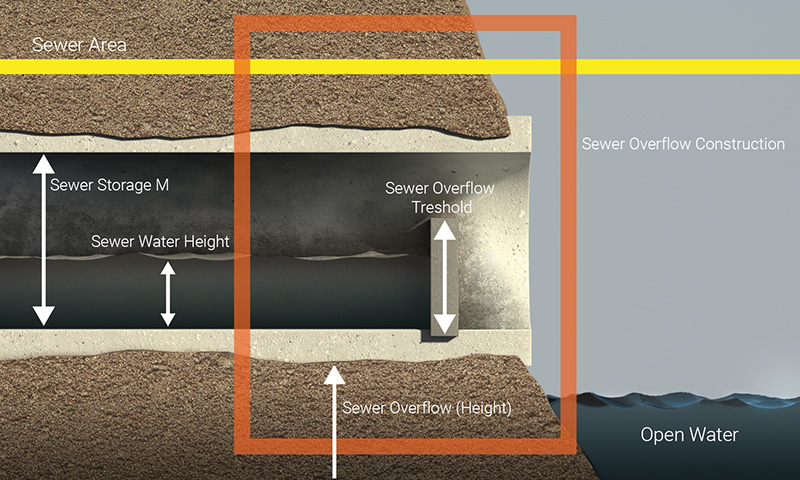
Schematic overview of a sewer overflow. 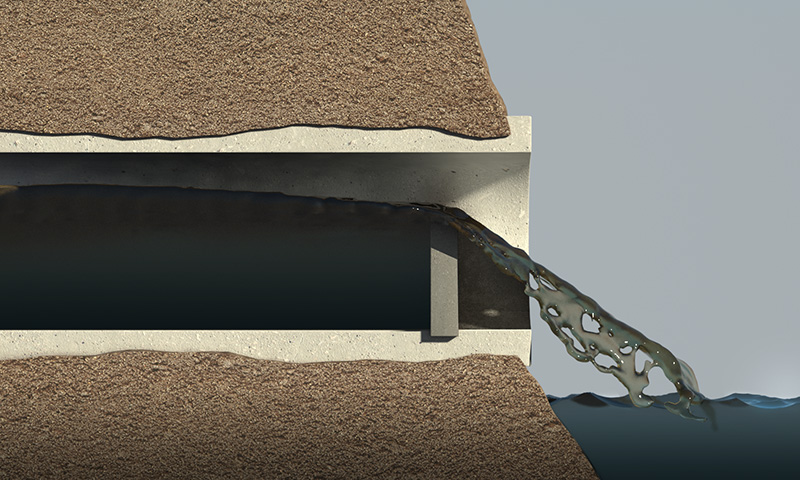
Schematic overview of water overflowing from a sewer.