Weir (Water Overlay): Difference between revisions
Jump to navigation
Jump to search
No edit summary |
No edit summary |
||
| Line 24: | Line 24: | ||
|howtos= | |howtos= | ||
* [[How to correct multiple buildings on the same location]] | * [[How to correct multiple buildings on the same location]] | ||
* [[How to correct weir | * [[How to correct weir or pump or culvert drawn as point]] | ||
* [[How to correct a building in an uninterrupted waterway]] | * [[How to correct a building in an uninterrupted waterway]] | ||
* [[How to correct a building at the edge of the project area]] | * [[How to correct a building at the edge of the project area]] | ||
Revision as of 08:53, 16 June 2026
Weirs are effectively small dams in the water, and allow water to flow from a water body with a higher water level to a lower water level. Any water exceeding the height of the weir can flow over it, increasing the throughput as the water level increases. Strictly, water can flow over the weir in either direction.
 A weir is a line-based building.
| Icon | Key | Unit | Range | Description | Default value |
|---|---|---|---|---|---|
 |
WEIR_HEIGHT | m + datum | -10000 to 10000 | The height of the weir. Water can flow past the weir when the water level exceeds the weir's height. | n/a |
 |
WEIR_WIDTH | m | 0 to 10000 | The width of the weir. | 5 |
 |
WEIR_ANGLE | geo angle (0-360°) | -1.7976931348623157E308 to 1.7976931348623157E308 | The top down orientation angle of the weir. | 0 |
 |
WEIR_COEFFICIENT | coefficient | 0 to 10000 | The flow coefficient related to the shape of the weir. | 1.1 |
 |
WEIR_N | exponent | 0 to 3.4028235E38 | Weir shape exponent | 1.5 |
 |
WEIR_TARGET_LEVEL | m + datum | -10000 to 10000 | The Weir can be configured to adjust it's height automatically in order to reach the target upstream water level. This parameter is optional. | n/a |
Notes
- If a weir is placed in a waterway, and the waterway is not otherwise interrupted, water might be able to flow past the weir via the waterway itself. In order to obstruct the waterway, one of two options can be chosen:
- Define the weir angle, in which case the Tygron Platform will automatically raise the DEM in the simulation based on the position, width and angle of the weir.
- Manually raise the terrain height using the terrain height tool or applying a terrain height GeoTIFF.
- Weirs can be imported as points. The Rasterization model and Water Module will always position a weir using its center-point, and orient its flow direction using the optional weir angle. The elevation is raised along the line perpendicular to the flow direction, up to the calculated dam width of weir.
-
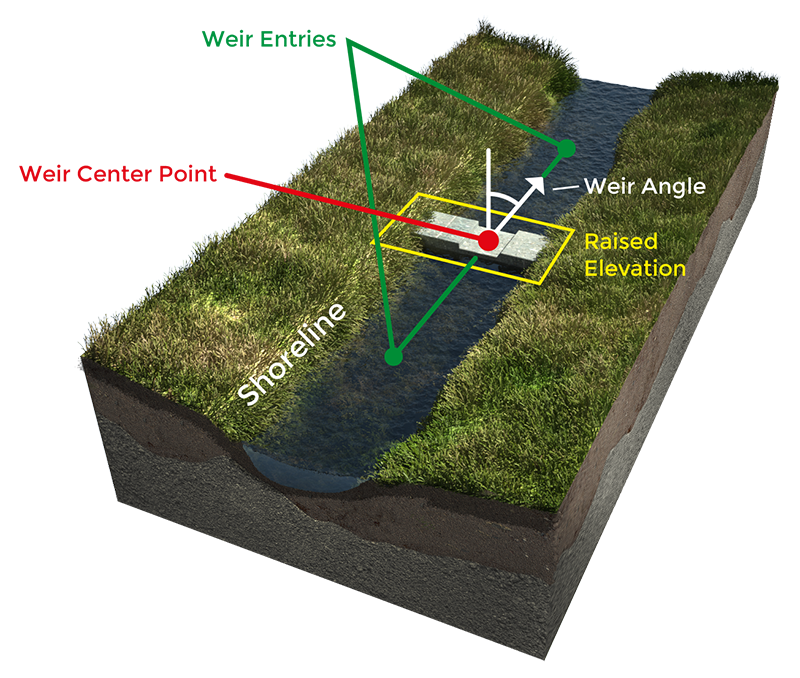 Weir placed along a waterway. Elevation is raised along the line perpendicular to the weir angle.
 -
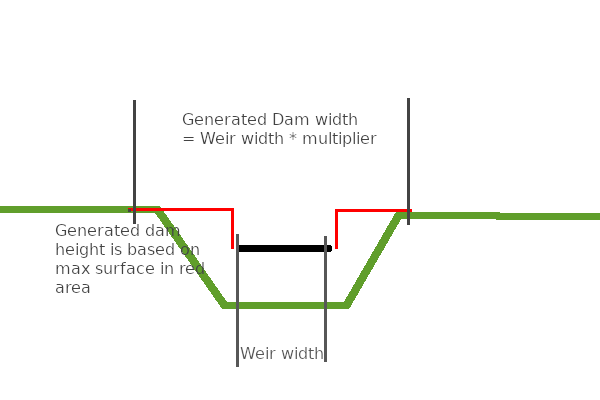 Perpendicular view of a Weir and the calculated calculated dam width.
.png)

How-to's
- How to correct multiple buildings on the same location
- How to correct weir or pump or culvert drawn as point
- How to correct a building in an uninterrupted waterway
- How to correct a building at the edge of the project area